
Model Cap Table

I thought it might be useful to post up a Cap Table Model that can be used by a pre-funding startup and then a financing can be layered in.  In other words, it shows both pre-money and post-money very clearly.  It is a simple model and NOT perfect, but it will work very well in most situations for you.  Here are things to note:

1.  Cells that are shaded yellow are input cells.  For example, cell E2 is the spot to put in the negotiated pre-money valuation.

2.  The model includes a simple waterfall analysis using both participating and non-participating preferred (see line 35 and then columns S and T).  The larger the preferred stock liquidation preference the larger the impact of participating preferred. Play with the investment numbers (increase them in column I).

3.  The option strike price in cell J1 is arbitrary.  I just set it at about 1/4th of the calculated Series A price.  But you should ask your accountants and lawyers about strike prices and Section 409A of the tax code.

4.  The green box at row 36 just provides a nice double check on post-money valuation calculations.

5.  Columns O and P are important as they show the % of preferred stock ownership compared only to preferred stock outstanding.  This is important as there are often charter or contractual provisions that require a preferred stock only vote.

6.  You really should try to focus on cell formulas.  They are simple, but critical to understanding how the cap table works and how valuable the cap table can be to your understanding of your stock holdings.

So….enjoy the model.  BTW, when I ask a company for its cap table (which I typically do as soon as I am actually interested in digging in further), I expect to get it in Excel (not PDF) and I expect to get it quickly.  If it takes a week to show up in my inbox I assume that the management team was not well prepared to pitch in the first place.

Ask any questions in the comments.  Thanks.
Ithaca College and Cornell and Colgate Universities – GREAT events!

The week of April 7th saw 3 events in upstate NY that broadly featured entrepreneurship!

On April 8th, we had a huge UVANY meeting/event at Ithaca College that featured student pitches from 9 different upstate colleges/universities and a keynote by Hamdi Ulukaya, the CEO of Chobani.  He was fantastic!  Here are 3 press hits that give all the details:  Press 1, Press 2, Press 3.

On April 10th and 11th, Cornell University held it annual Entrepreneurship@Cornell Celebration.   Here is a link to the schedule.   Key features were the eLab Demo Day (eLab is Cornell’s student business accelerator; see live stream link here – start at minute 10), a moderated discussion with Jeff Boyd, the current Chairman and former CEO of Priceline, and recognition of the 2014 Cornell Entrepreneur of the Year, Greg Galvin.

And finally, kudos to the Colgate University entrepreneurship team for hosting a great event called Entrepreneurship Weekend on April 11th and 12th.  Here is a video clip of the featured panel, which had a star studded cast, including Ashton Kutcher.

What a powerhouse eship week!

The Grind

The other day I was guest lecturing in a class and described running a startup to be like swimming in a Shawshank River.  There is a constant flow of problems building a company, but at the end might be salvation!

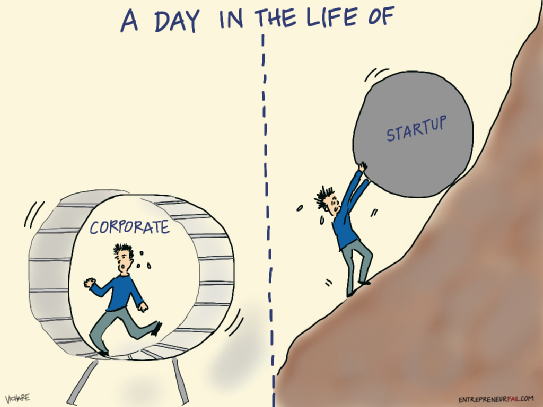
A friend of mine just sent me this cartoon, which has a different take on startup life.  Nothing revolutionary here, but I loved it so thought I would share.   If you don’t like the hamster wheel, start your own company!


startup vs corporate

Filling Out the Round

I like the practice of VCs giving term sheets that provide for a specific size for the total round and then stating how much the specific VC will contribute.  For example, “VC will serve as the lead investor up to $400,000; Company would source balance of the round up to $600,000 (so round size would be up to $1,000,000 in the aggregate).”

At the early stage, the founding team often has lots of “interest” lined up waiting for a lead.  I hear this often.  Well, the structure described above solves that problem.  And it also puts the founding team to the task – VC stepped up to lead so now go and fill out the round!

From my perspective this serves as a test for the founding team; and it is an important test.  It serves to validate their claim about having enough interest to fill out the round and also proves their ability to get that done.  Even after the lead investor steps up and provides a term sheet, getting remaining hard commitments is incredibly challenging and can take weeks or even months!

Another interesting point about making it clear that the founders (or subsequent management team) need to fill out the round is that it sets a tone for going forward fund raising responsibility.  I love to help our portfolio companies raise investment capital, but the buck stops with the management team – it is the team’s responsibility to raise capital.  Sometimes it seems that this responsibility never stops.  I like reinforcing from the earliest interaction that the management team (might be the founding team) of a VC backed company can never delegate the fund raising responsibility.  We (the VCs) can help, but the effort will fail if not led by the team.

Go raise some bucks!

Positive Energy

Positive Energy inside a startup is the critical asset to make things tick.  Building that Positive Energy is the job of the CEO and the senior team. Building comes in different forms.  I love this example of Positive Energy.  Fun, makes you smile, makes you think something is going right inside that company!  Makes you want to work there.

Go GiveGab!