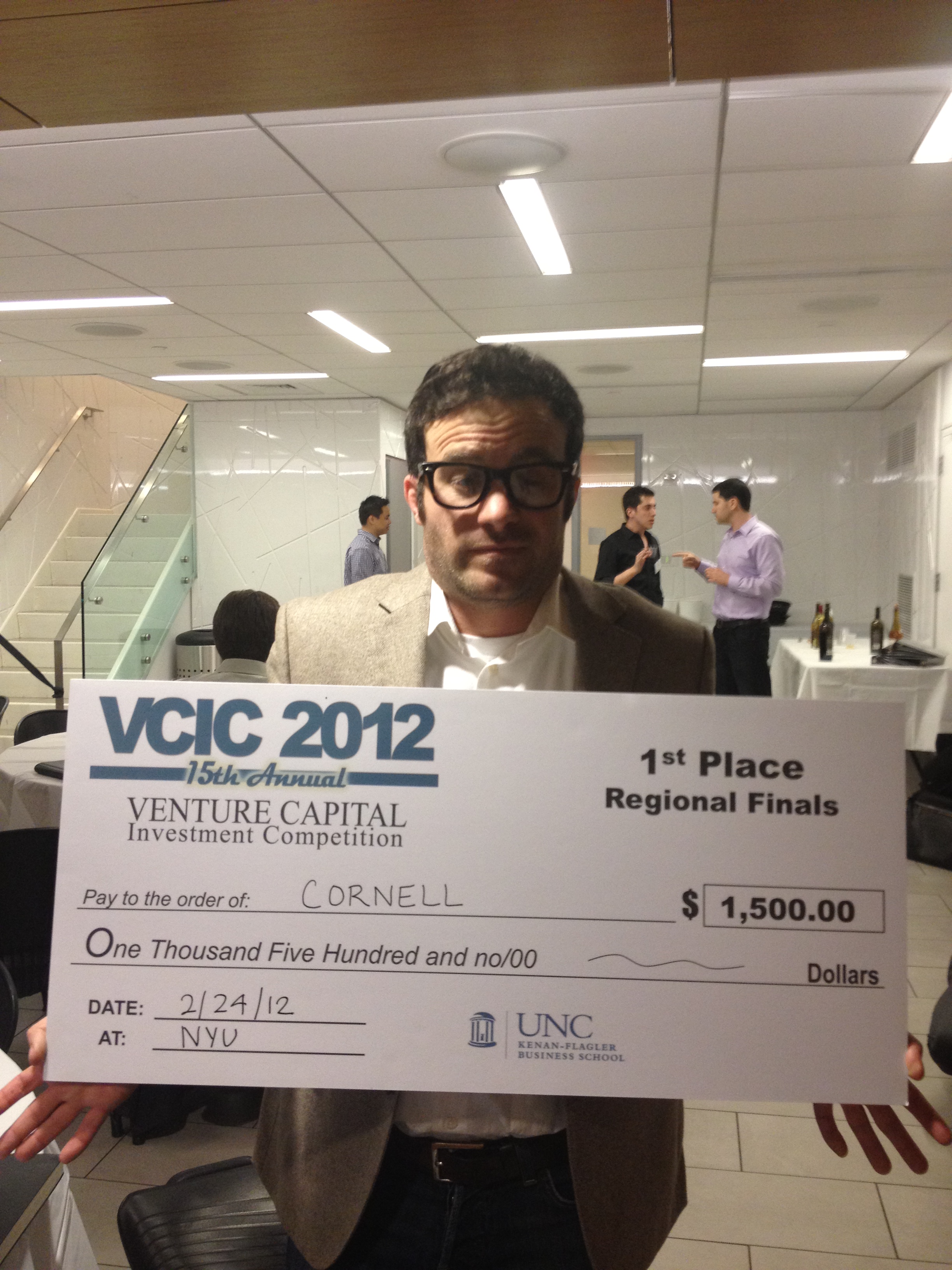
Johnson School Team Wins Regional VCIC Competition

Great news:   today a team of Johnson students from Cornell University won the regional VCIC competition in NYC.  They competed against Columbia, Rochester, Purdue, Johns Hopkins and Yale.  Next stop is the finals in Chapel Hill April 12-14.   Go Cornell!!

Here is a picture of one of our finest holding the winner’s check (clearly the contest was won for facial expressions):


VC and Marking Investments to Market

It is the time of year when VC firms do year end valuations for their portfolio company holdings.  While not as bad as water boarding, this exercise always makes my stomach turn.  Luckily, I am not in charge of the internal finance function at our fund.

Most of my stomach turning results from the fact that this exercise is purely about unrealized return values of purely non-liquid assets (unless of course there is an active secondary market for the stock – this applies to a few handfuls of VC backed companies).  FAS 157 and other accounting rules require such a valuations be done, but what is the real value of doing them?  Yes, large institutional investors use the unrealized values and need them for reporting purposes.  I get that and understand it.  But unrealized values are sometimes rather illusory in that they are based on what are called “Level 3” inputs that by definition are often not exact and even non-quantitative.

Some VC firms use the art of Level 3 inputs to mark up their valuations, which has a tendency to make limited partners happy.  I think this practice is not prudent.

My easy solution for VC firms would be to mark up or down the valuation of investments based only on new independently led outside rounds of financing.  An inside round could only result in a mark down (if the new inside round was a down round), but not any mark ups (if the new inside round was an up round).  This rule would keep the process simple and very conservative, which I think is sound.

It is easy to tell your LPs that the valuations are conservative…..


Startups Paying Bonuses…..an Oxymoron??

I am a huge believer is paying bonuses when a company can afford to pay them.  And there lies the issue.  How do you define “afford”.  I like to define it as having positive cash flow at year end to cover the payments.  Positive cash flow in this context = profit.

With that definition, here are some things that would not qualify:

  • “Hey, sweet, we just closed a $3mm Series A”
  • “We rock, we just signed an agreement with the largest distributor in the country!
  • “Sweet!!  We just got FDA approval for a new drug”
  • “Guess what – it is end of year holiday time!”

I hope you sensed a little bit of sarcasm in my text tone.  But yes, I have heard these and more.   Closing a Series A has nothing to do with profits; the investors want the $$ used to build a business.  Signing a large distributor has nothing to do with profits until you start selling lots of product (hopefully at a hefty profit) to the distributor.  Likewise for FDA approval – start selling the drug.  And holiday time, the biggest offender, has nothing to do with profits  and everything to do with emotion.

Motivating the team is obviously key.  Do bonuses motivate?  In general, it is hard to say that they don’t at least help to motivate.  So, at startups its is critical in my view for the CEO to set the tone from the beginning in terms of when bonuses can be paid.  If the team knows from the beginning that bonuses derive from profits that will serve to manage expectations well.  I think of the bonus mentality as an evolution that the CEO controls.

[just pushed “publish” instead of “save”…..sorry….here is the rest]

With respect to holiday time recognition the evolution might look something like this:  Year 1, holiday party.  Year 2, holiday party with $30 Starbucks gift cards.  Year 3, holiday party with $100 Apple Store gift cards.  Year 4, holiday party with $2000 cash bonuses (assuming profits exist to cover them).  Again, the expectation management is the critical component that must be managed from the top.

With all this said, I am 100% fine with paying a one-off bonus regardless of profits to a particular team member for an extraordinary effort.  For example, perhaps the head of bus dev did such an amazing job getting that big distributor signed up that the board decides to pay a “thank you” bonus to this person (despite the fact that the bus dev guy’s job is to get such big contracts signed up).

Look forward to your comments.

No Mess (Hanging Deferred Comp)

It is really easy to underpay yourself in a start up.  After all, there is typically not enough $$ to pay yourself well or at all.  It is easy to cut your salary during a cash flow crunch.  By using the word “easy”, I do not mean easy as in fun or simple.  Rather I mean easy as in you have no choice.  And having no choice is not too easy!

Prior to receiving outside funding, founders often work for very little salary.  Ideally, everyone is motivated by their equity stake and the hope of future reward.  A serious issue arises when the “salary not taken” shows up as deferred compensation on the company’s balance sheet or rears its head in discussions with potential funders.  This is not going to make for a pleasant talk.  It also makes for a messy balance sheet.  It is difficult or impossible to get deferred compensation paid once you have outside investors.  I think the most important point here is actually expectation management.

A similar situation arises when bonuses are granted even though they cannot be paid due to lack of cash.  Is employee moral boosted by paper bonuses that might get paid in the future if cash flow improves?  Doubtful.  I am guilty of falling into this trap as a board member.  The situation never ends well and, again, a messy balance sheet results.

I love to approve bonuses when cash flow exists to pay them (i.e., hey, we are selling product and making some profit).  I love paying market salary when cash flow exists to support.  I wish my VC fund were larger so that I could get paid more out of our management fee.   Reality is……it is not.  Reality is…..the payday hopefully comes later with exits.

Luckily, we don’t carry any deferred salaries on our books.